


FAQ
Why choose geothermal?
Can a geothermal system provide both heating and cooling?
How much space is required for a geothermal system?
What’s involved in developing a geothermal project?
How long does installation take?
Can geothermal work for my site?
Geothermal accesses the steady energy beneath the ground to deliver heating and cooling with exceptional efficiency and reliability. It performs consistently throughout the year, even in extreme weather conditions, and uses significantly less electricity than other technologies.
Because it draws from a constant natural resource, geothermal reduces emissions, operating costs, and grid dependence while providing quiet, low-maintenance energy.
It’s long-life infrastructure — not a short-term retrofit — designed to decarbonise heat at scale and secure your energy future for decades to come.
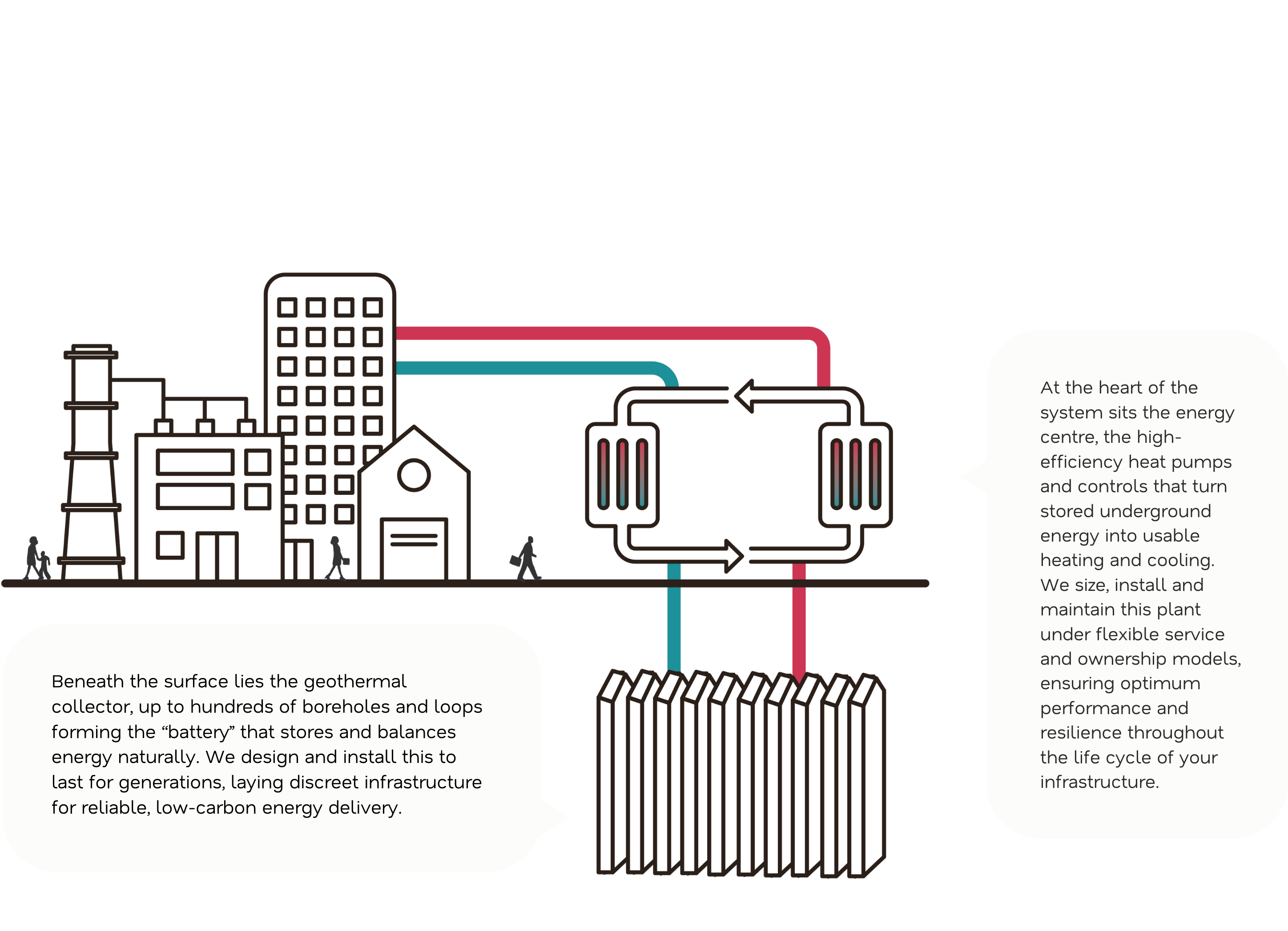
Yes. A geothermal system is naturally reversible. It exchanges heat energy between the earth and your thermal energy load. This creates a balanced, regenerative thermal energy battery that stores and reuses energy for year-round comfort and meeting your energy demands.
It’s one of the core advantages of geothermal and should sit at the heart of any decarbonisation strategy.
That depends on your energy demand and the ground conditions beneath your site.
Systems can be designed beneath buildings or landscaped areas, using the available footprint efficiently. Each thermal energy battery is engineered as long-term infrastructure — built to last for at least a century and deliver consistent performance with minimal visual impact.
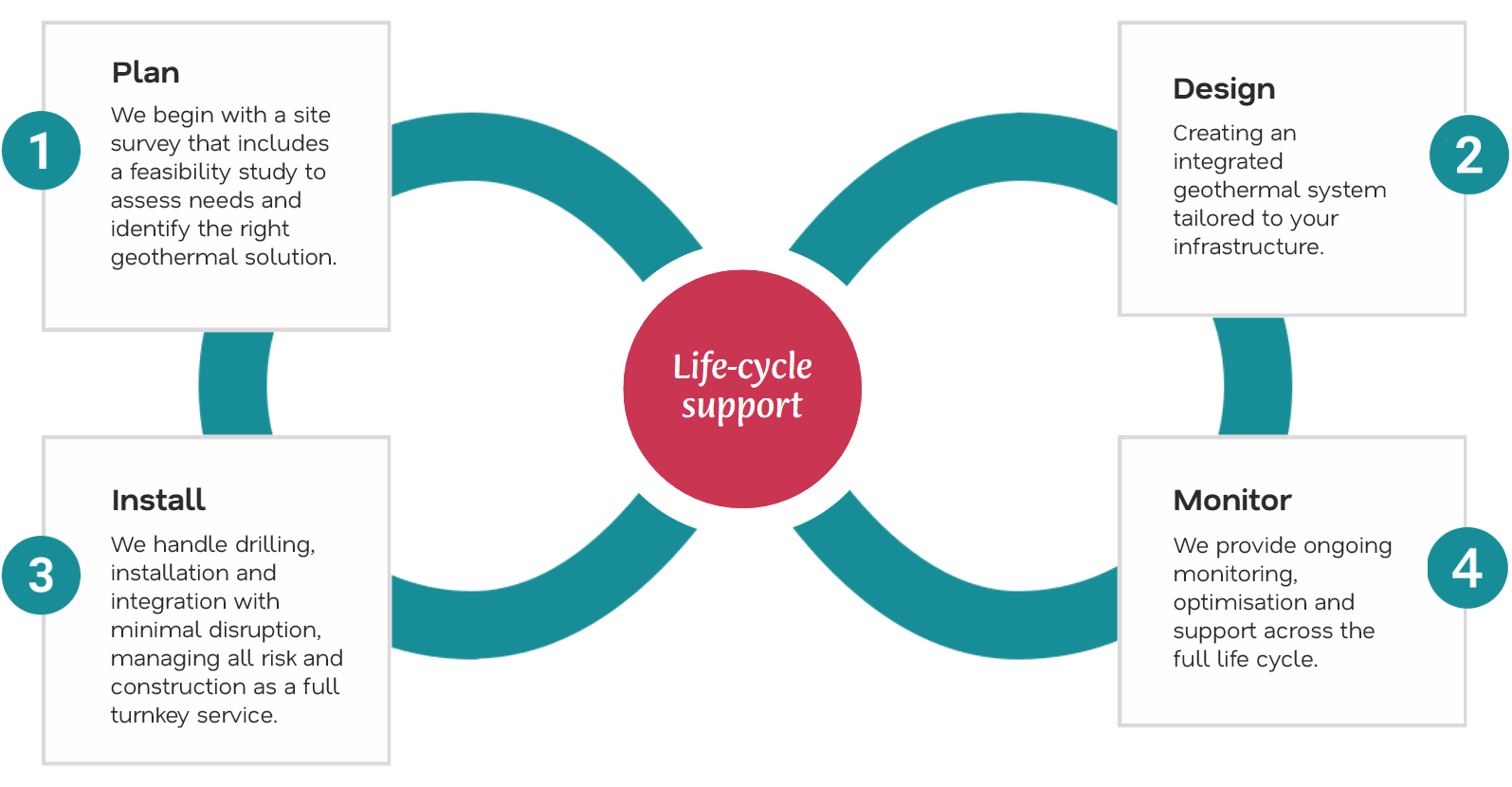
We manage the entire process — from early feasibility and ground testing to full system design, construction, and ongoing performance monitoring.
Our full-service approach gives you clear visibility and control at every stage while removing the complexity of decarbonisation.
Most commercial systems are completed within 9–12 months, from feasibility to commissioning. Smaller projects can move faster.
The drilling and testing phase takes the most time, but it’s what guarantees efficiency and reliability for decades to come.
In most cases, yes. Geothermal performs best where there’s a consistent demand for heating and cooling — such as offices, universities, hospitals, airports, industrial facilities, historic buildings, and large mixed-use or residential developments.
The first step is a feasibility assessment. This matches your site’s ground conditions with its energy demand to determine the most effective and economical design.
FAQ
Because it draws from a constant natural resource, geothermal reduces emissions, operating costs, and grid dependence while providing quiet, low-maintenance energy.
It’s long-life infrastructure — not a short-term retrofit — designed to decarbonise heat at scale and secure your energy future for decades to come.
It’s one of the core advantages of geothermal and should sit at the heart of any decarbonisation strategy.
Systems can be designed beneath buildings or landscaped areas, using the available footprint efficiently. Each thermal energy battery is engineered as long-term infrastructure — built to last for at least a century and deliver consistent performance with minimal visual impact.
Our full-service approach gives you clear visibility and control at every stage while removing the complexity of decarbonisation.
The drilling and testing phase takes the most time, but it’s what guarantees efficiency and reliability for decades to come.
The first step is a feasibility assessment. This matches your site’s ground conditions with its energy demand to determine the most effective and economical design.
